
Dear friend,
The riddle first, as the tradition demands. Back in the old town, two knife grinders worked the same streets, and the one who never once argued that his work was good ground twice the blades.
Two knife grinders in one town, the same treadle wheel and the same fourpence a blade.
Both worked the same forty streets, and neither ground a truer edge than the other.
Both were asked at the door whether a kitchen really wanted it, and how often.
One answered that a keen edge saves labour and spares the meat, which is perfectly true.
One answered with the number of kitchens in that street who had theirs done three times a year.
Why was the second man's round two days longer by the following spring?
Hold your answer. Story time.
The Story
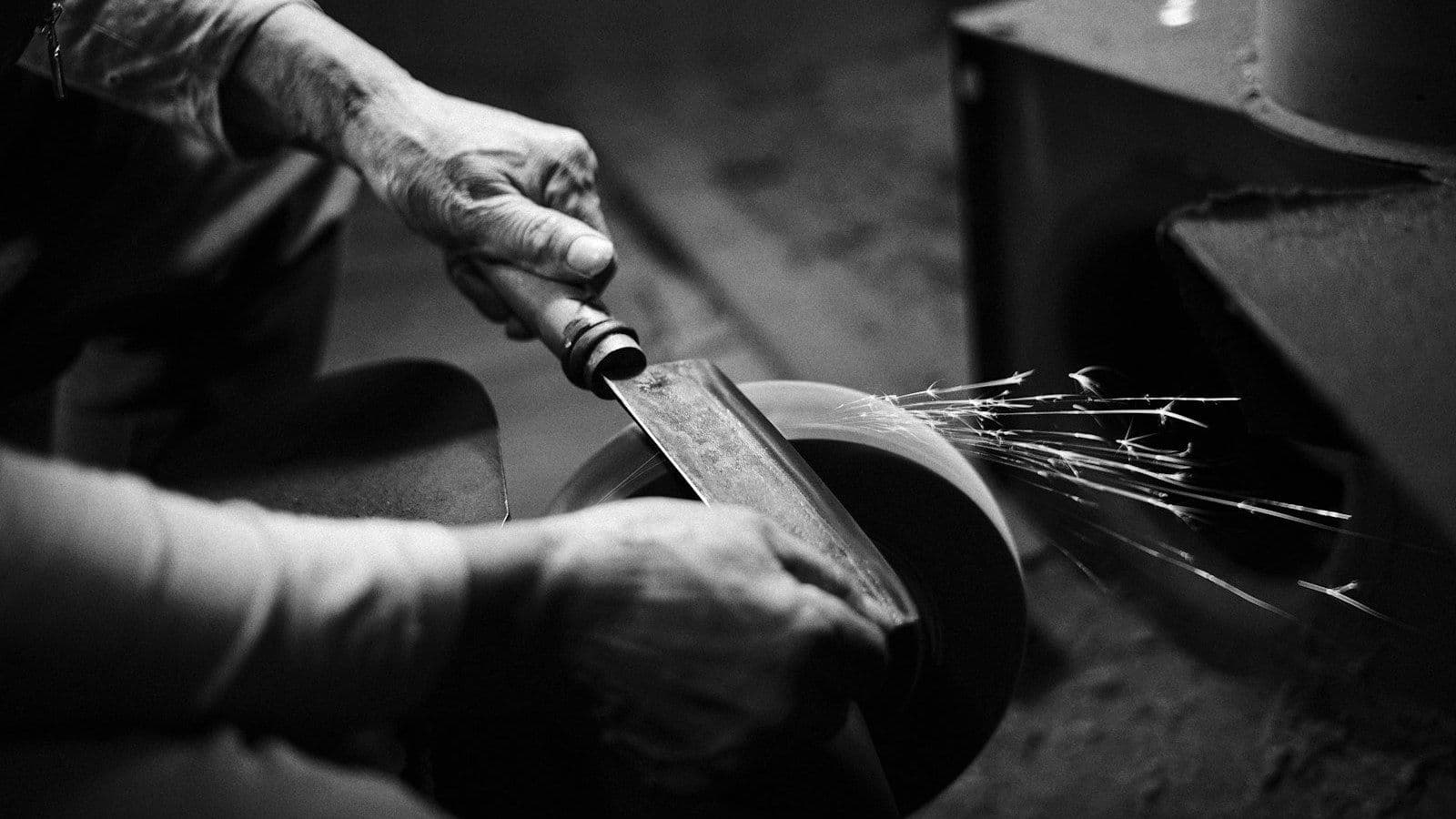
Two knife grinders in the town I've never named, working the same forty streets between them. A handcart, a sandstone wheel turned by a treadle, a can of water set to drip on the stone, a leather apron gone black and stiff, and that long rising note a blade makes when it is held right. Both men were good, the first arguably the better for having served a cutler, and both could grind a kitchen's knives so that a woman felt the difference in the first onion.
Both were asked the same question at the scullery door several times a day. The householder would turn her knife over as though seeing it for the first time in a year. Did a kitchen really need a grinder, and how often?
The first grinder had a good answer ready. A blunt knife makes you push, he would say, and a knife you push with is the knife that slips. It tears a joint instead of cutting it and wastes the meat along the bone. All of it true. Perhaps a third of the time it got him the knives.
The second grinder had given that answer up years before, not from any theory but because he watched what it did. They agreed warmly, said they must see about it, then looked at their own three knives with no idea whether a woman in their position had hers ground once a year or once a month. So they did what anybody does who cannot tell what is normal. Nothing.
So he kept his book differently. Not only takings, but the streets, the houses and the dates. By the second year he could say a thing nobody else in the trade could say at all. Twenty-two kitchens in this street have theirs done, he would tell her, most of them three times in the year, at Lady Day, in August and the week before Christmas. The houses either side of yours are among them.
He said it the way a man gives the time of day, neither boasting nor reproaching. He was telling her what her own street already did, and a woman who has been told that is no longer deciding whether knife grinding is sensible. She is deciding whether she is the one house on the row that does not bother.
There was a second difference, and it worked against the first man without his knowing. In a lean February he said what tired men say on a doorstep. Nobody bothers with a grinder these days. Everybody makes do. It was a true account of his own takings, and every householder who heard it was told that making do was what this street did. He spent his thin months teaching the habit that kept him thin.
By the following spring the second grinder's round took two days longer than it had, and he had put his prices up a penny without losing a house. He had not won the argument. He had never had it.
The Lesson, Since You've Earned It
A buyer who cannot judge your work for himself will copy people he takes to be like himself, so the most persuasive sentence you own is a plain, true account of what your other customers actually do, and how often. Not what they think of you. What they do.
This is not a trick. Most of what we buy, we are not qualified to assess. A householder cannot tell a well ground knife from a badly ground one until it is in her hand, and cannot tell at all whether three times a year is prudence or extravagance. Settling that from first principles would cost her an afternoon, over a shilling. So she reads the behaviour of people near her, which is free, and which carries a second comfort besides: nobody is called a fool for doing what the neighbours do.
It is also why good words from your customers do less work than you expect. Praise tells her you are capable, which she probably assumed. What she is stuck on is whether this is a thing people in her position do, and how often, and that is not in a folder of kind letters. People buy from their own, and they also buy what their own are buying.
Such a sentence also does a reminder's work without sounding like one. To say the street has theirs done three times a year is to say, without instruction, that hers are due. Most trades have an interval nobody has said out loud, and the customer has simply never thought about it.
Two cautions. First, the number must be true, counted, and stated at the size you actually have. Eleven of the fourteen houses on this lane will survive being questioned. Everybody has it done will not, and the customer who asks which everybody costs you more than the sentence earned. If your figure is small, name the small group it is true of: this street, this trade. A norm moves only the man who can see himself inside the group you name, which is why thousands of satisfied customers nationwide moves nobody at all. Second, mind what you say in a thin month. Trade is quiet, nobody bothers these days, people are cutting back. Each tells a customer that not buying is the reasonable course.
Three questions, and the first takes an evening:
- What do your customers actually do, and how often? Go through two years of your book and count it: how many, in what trade or area, at what interval. You want one sentence of arithmetic you can say at a door.
- Which group does the sentence name? Read it back and ask whether an ordinary customer would say yes, that is me. This street, this village, firms with three vans. If nobody can stand inside the group, the sentence is only decoration.
- Where are you publishing the wrong norm? Look at your website, your quotes, and what you say when a job is slow. Strike out every line reporting that most people do not bother.
The Answer to the Riddle
Why was the second man's round two days longer by the following spring? Because the first grinder spent his days answering a question nobody was asking. They did not doubt that a sharp knife was better. They doubted whether having it seen to was a thing women like them did, and how often. No argument about edges answers that. Only a count of the neighbours does, and he had the count.
The verse:
One man stood upon the step and proved the case was sound,
One man named the twenty-two whose knives he came around.
The first was right at every door and heard the bolt go to,
The second never argued once, and ground the whole street through.
Until next time. Go and count, from your own book, how many of your customers in one street or trade buy at what interval, and write that sentence down.
The Best Time for Trying was Yesterday...
Ben B. Tilley
P.S. You cannot write this sentence at a desk. It has to be counted out of your own book, which means the trader who ends up with one has also found out, in the counting, which streets he is thin in and which months his customers truly buy in. I have never known a man do that arithmetic and learn only the one thing.
Also in the archive: The Mason's Witnesses, There Is No Crowd and Who Sent You.