
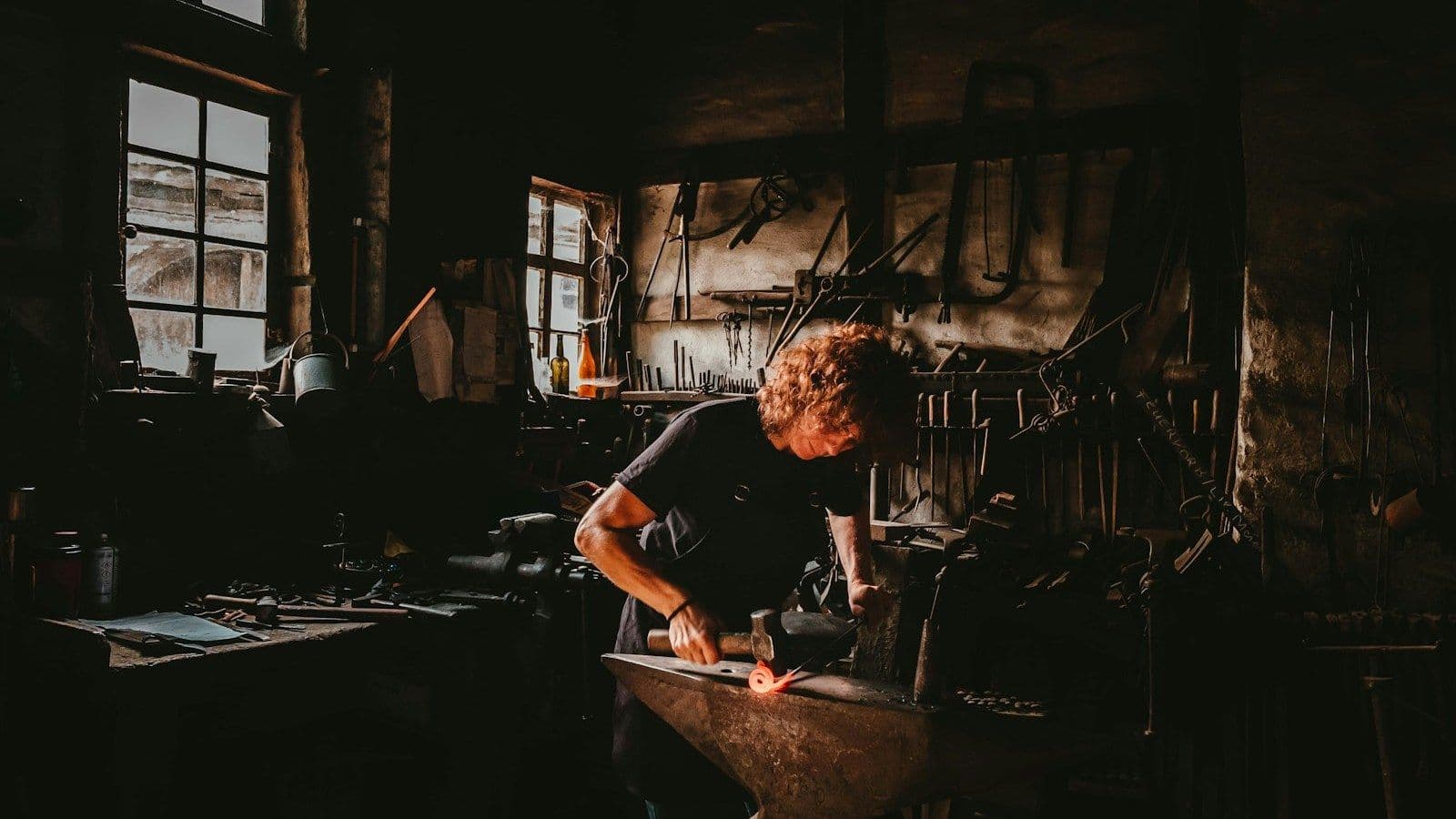
Dear friend,
The riddle first, as the tradition demands. Back in the old town there were two blacksmiths, and the difference lay in neither the iron nor the price, but in what each gave the customer to check.
Two smiths in the town I have never named, the same bar iron and coke, the same scrollwork learned from the same master.
Both were asked to price a pair of gates for a carriage entrance, and both went and looked.
One said he would come early in the week and a figure would follow shortly, and both things happened, late.
One named an evening and an hour, came at the hour, and named a second hour for the drawing.
The first asked nineteen pounds, the second nineteen pounds ten, and the second got the gates.
Same iron, same hands, same parish. What had the householder weighed?
Hold your answer. Story time.
The Story
A pair of gates is a dear thing to buy and an impossible thing to judge. The householder had seen ironwork about the parish that he liked, and could not have said what it was worth, nor whether the scrolls were forged or cast, nor which of two smiths would hang a gate that still shut true in ten years. He knew what he wanted it to look like, and took the rest on trust.
The first smith was the busier man and the better known, with gates standing in half the lanes about the town and a yard that smelled of hot scale and was never quiet. Asked when he could come and measure, he said early in the week, most likely the Monday. He came on the Wednesday afternoon, sorry about it, with a true reason involving a broken tire on a wagon. He measured carefully, talked well about the hinges, and said a figure would follow within the week. It came eleven days later on paper torn to size, a fair and honest nineteen pounds for work that would have been worth it.
The second smith was younger and had less standing. Asked the same question, he said he would come on the Monday at seven in the evening, and was at the carriage entrance at seven with a rule and a pocket book. He spent twenty minutes of the visit on the ground rather than the posts, the fall of the drive being what would decide whether a gate dragged. Before leaving he said one further thing. He would bring a drawing of the scrollwork and his figure on the Thursday evening at six.
On the Thursday at six he was at the door with a sheet of brown paper, creased at the fold and damp along one edge from the walk over. The top half had the gates drawn out small. The bottom half had one scroll drawn full size, so that a man who knew nothing of ironwork could hold it against his own gatepost and see it at the size it would be. Underneath, in the same hand, nineteen pounds ten, and the two weeks he would want.
The householder took the second man and paid the extra ten shillings. His wife had been left waiting the previous autumn by a man who was to have come about a kitchen range, and had spent a fortnight unsure whether to send for somebody else. None of this was said aloud to either smith. They would have told you they chose him for the drawing.
The Lesson, Since You've Earned It
A customer who cannot judge your trade will judge the only work of yours he has watched you do, which is the work of selling to him. He has no instrument for hinges and scrollwork. He has a perfect instrument for seven o'clock, and it is in his waistcoat pocket.
This is not a trick of the mind to be exploited. It is sound reasoning on the customer's part, and you would do the same in his place. Promises kept about small stated things and promises kept about large unstated ones come out of one habit, which is writing down what you said and treating it as owed. A man loose with an hour he named himself is showing you his system, and he has none.
Every selling period already contains such promises, whether you place them there on purpose or not. You will say when you can come, when a figure will follow, when you will have the ironmonger's delivery date. The question is never whether to make them, only whether yours can be checked. Early in the week cannot. Within the week cannot. I will get something over to you shortly can be neither kept nor broken, and so earns you nothing when you honour it, which is the whole loss.
So place them deliberately. One per enquiry is plenty: small, cheap to keep, carrying a day and an hour. Then keep it to the hour, including the inconvenient ones, since those are the only ones that prove anything. A stranger will take the first thing of yours he can time as a sample of the rest, which is exactly what it is.
There is a second virtue here, and it is why to begin this week. This is the one piece of proof you own outright. Your workmanship is unseen until the gates are hung, and the good words of past customers belong to them and not to you, proof being worth more than praise in any case. But an hour named and met is yours, costs nothing beyond the ordering of your own week, and is available in the next enquiry through the door, with no history behind you. The younger smith had none of what the older man had. He had Thursday at six.
Two cautions. The first is the temptation to promise three things where one would do. Three half-kept promises are worse than none, since a man punctual twice and silent once has told the customer that his word is weather. Make the one promise easy and name a date you can beat. The second is that you must not mention it. Hand over the drawing and remark that you always do what you say you will, and your evidence has become a boast, to be weighed as one. He noticed the hour. Say nothing.
Three questions, for the week in front of you:
- In my last three enquiries, what did I say I would do next, and did it carry a day and an hour? Most trades find they promised nothing checkable, then wondered why being reliable did them no good.
- What one small thing could I promise in every enquiry that costs under an hour and can be verified? A drawing, a sample, a figure by a named evening, a call at a named time. It need not be impressive. It needs to be dated.
- Where does my record of what I said live? If the answer is in my head, you keep the promises you happen to remember, which is a different trade from keeping the ones you made.
The Answer to the Riddle
Same iron, same hands, same parish. What had the householder weighed?
Not the ironwork, which he could not weigh. He weighed the two things each smith had let him test: an hour named and met against an hour named loosely and missed, and a drawing delivered on the stated evening against a figure that came when it came. He paid ten shillings for the only evidence he had.
The verse:
He cannot judge your iron and he cannot judge your fire,
He has no rule for hinges and no eye for what is true,
But the clock upon his mantel is a judge that does not tire,
And the hour that you promised him is all he has of you.
Until next time. Go and put a day and an hour on the one thing you last told an enquirer you would do next.
The Best Time for Trying was Yesterday...
Ben B. Tilley
P.S. It runs the other way too, worth knowing when you are the buyer. Where you cannot judge a trade, set the man a small dated thing instead. Ask for one figure by Friday evening. What comes back, and when, tells you more than an hour of questions about his experience, which he will answer well whatever the truth is.
Also in the archive: Eleven Years of Weather, Let Them Try It and Unless I Hear Otherwise.