
Dear friend,
The riddle first, as the tradition demands. Back in the old town a man might leave one kitchen in high spirits and the next in a sweat, and be wrong about both before he reached the lane.
Two cartwrights in the town I have never named, the same ash and the same elm.
Both asked eighteen pounds for a harvest cart, and both were worth it.
Both spent the same Tuesday on two farms, and came home with two conversations.
One kept hold of the farmer who had agreed with every word he said.
One kept hold of the farmer who had quarrelled with him about the wheels.
Same trade, same price, the same two farms. Why did one of them build the cart?
Hold your answer. Story time.
The Story
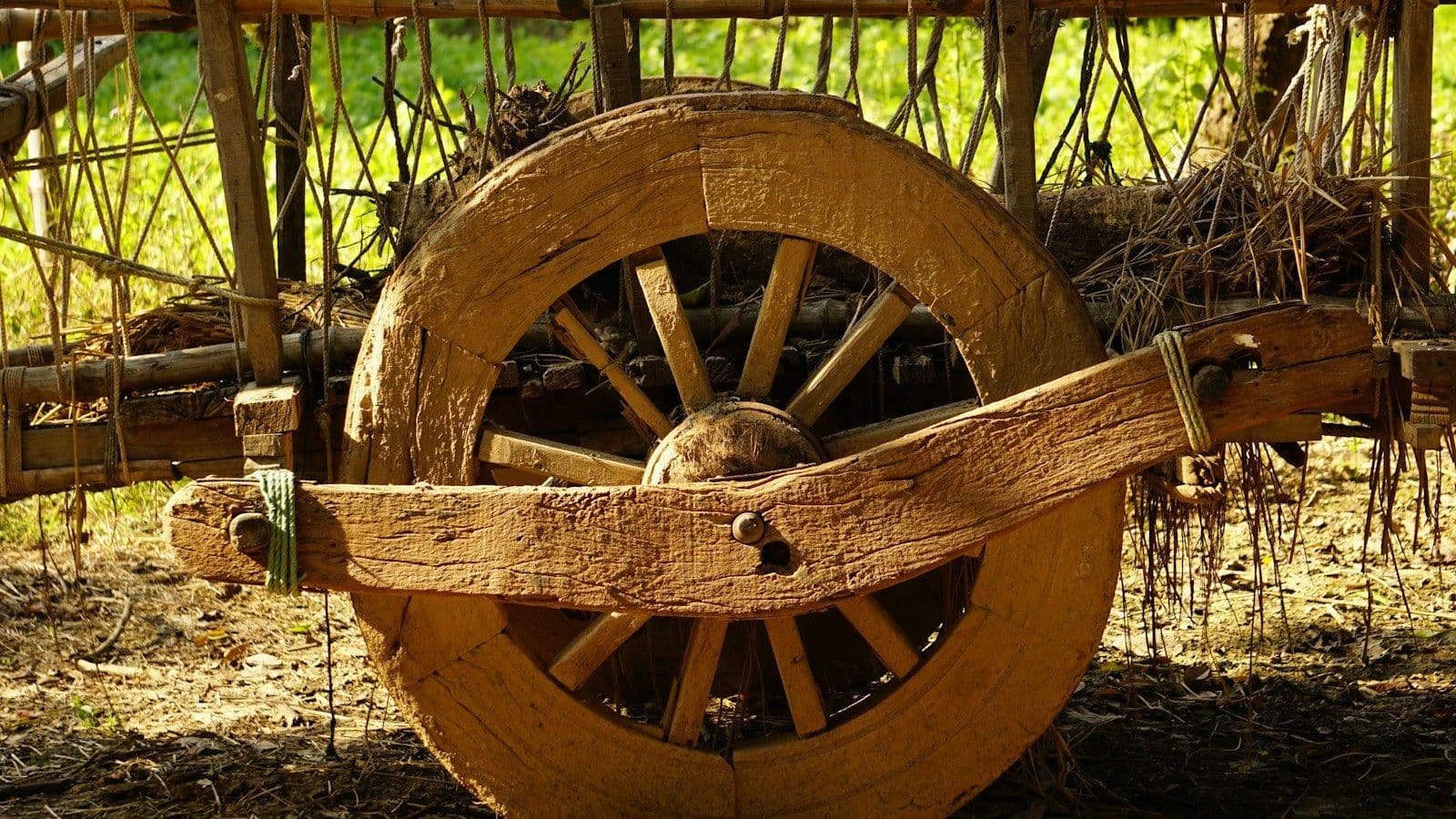
The trade is cartwrighting. Elm for the hub, oak for the spokes, ash for the felloes, and the iron tyre laid in a ring of burning brushwood until it grows, dropped on glowing and quenched with water so that it shrinks and pulls the wheel tight in four seconds. Both men could do it, and neither was cheaper by a shilling.
On the Tuesday both saw the same two farmers, each wanting a cart by harvest.
The first farm was a grazier up on the chalk. Tea in the kitchen, the dog under the table, half an hour of the pleasantest talk a man could ask for. The price was fair, said the grazier, and the wheels handsome. His father had had a cart from that very shop, standing in the barn yet. He would be in touch once the hay was in.
The second farm was a tenant down on the heavy land, and that half hour went differently. The wheels were too narrow in the track, he said, and he had gone out and measured his own gateway to prove it. The ironwork was dear. He could not be without a cart in September. He wanted to know whose expense it was if a tyre worked loose in the first winter. Then he asked whether half the money might wait for Michaelmas and the wool.
The first cartwright drove home pleased with the chalk and sour about the heavy land. He wrote out the grazier's estimate and waited to hear from the man who had admired everything.
The second cartwright spent Wednesday on the tenant. A drawing with the track widened to the gateway he had the width of. A delivery day in the last week of August. A line saying a tyre off inside twelve months came off at his own cost. Half the money to wait for the wool. He was building the cart by the middle of the month.
The grazier was just as pleasant the following April, still using his father's cart.
Mark what happened on the heavy land. Every awkward thing that tenant said was a report from a man who had already taken delivery in his head. He had driven the cart through his own gateway, which is how he came to measure it. He had got through September with it, and had the tyre come loose in February and wondered who was to pay. The grazier had not got as far as the gateway.
The Lesson, Since You've Earned It
A customer who argues with the details of your estimate has already begun using the thing in his head, and a customer who agrees with all of it has not begun at all. The quarrel is not an obstacle in front of the sale. It is the only evidence you are given that a sale is being considered at all.
Consider what each man spent. Agreeing with you is free, commits him to nothing, and is therefore worth nothing as evidence, which is also why a pleasant question gets a pleasant answer. Objecting costs something. Few people enjoy telling a tradesman to his face that his price is dear and his wheels are wrong, and nobody pays that over a cart he does not mean to buy.
There is a second thing in it, and the more useful. An objection is specific. To make one at all a man must have run your work through his own circumstances, and those are the gateway, the September, the wool money. That running through is the whole of buying. It happens inside the customer and you never see it; the objection is the one part that reaches you out loud.
Now the part most trades get wrong. They allocate the week by the signal. Thursday goes to whoever was charming, and the difficult farmer becomes somebody else's customer. The worst case is the conversation with no friction in it at all, which means one of two things, and they look identical from where you stand. Either he decided before you arrived, in which case stop talking and take the order while it is in the room, or he has not begun, in which case you have nothing. Tell them apart by asking the question he has not asked. Most people, you say, want to know what becomes of a tyre that goes loose in the first winter. A live hesitation comes up then, with relief, because you have made it respectable. A man who has decided waves it away and asks when you can start.
One more test, for the man who objects to everything. Watch whether his objections narrow. Wheels, then the date, then the Michaelmas money is a line closing on a decision, each answer settling ground that stays settled. Wheels, then whether a new cart is wanted at all, then his brother-in-law's opinion, closes on nothing. Narrowing is buying. Widening is a pastime, and yours to end.
Two cautions. Do not manufacture doubt. Naming a hesitation other customers have really had is not inventing one, and once you have named and answered it you shut your mouth, because a trade that keeps raising settled difficulties talks itself out of the work. And hear the objection that is not to the detail but to the premise. A man who does not believe the job needs doing is not inspecting your estimate. Answering him line by line is wasted; what he lacks is a reckoning of what another year of the old cart costs him.
Three questions, for the week in front of you:
- What was the pleasantest conversation I had last week? Now say what the customer had to work out for himself. If the answer is nothing, you have an admirer, not an enquiry.
- What were my last three arguments actually about? It will be a short list, much the same every year, and most of it can be answered before anybody raises it.
- Whose objections are getting narrower? That is where Thursday belongs, not with the man who agrees with you.
The Answer to the Riddle
Same trade, same price, the same two farms. Why did one of them build the cart?
Because the quarrel was the only proof either man was offered that a cart would be bought at all. The grazier had approved of a thing he had not yet imagined owning, and approval of that kind lasts years without becoming an order. The tenant had been using the cart since the second minute, and every complaint was something he found while using it. One man answered the complaints. The other kept the compliments.
The verse:
The man who says nothing against you
Has nothing as yet to defend,
The farmer who quarrels about your wheels
Has driven the cart to the end.
Until next time. Go and find the smoothest conversation of last week and put to that person the awkward question they never asked.
The Best Time for Trying was Yesterday...
Ben B. Tilley
P.S. The same rule governs the written estimate. A reply asking why the second line costs what it does is worth four thanking you for your trouble. An estimate that draws no questions has usually not been read, so put in it something a man must answer: a date to confirm, a choice of two widths, a figure to include or leave out. His silence then becomes information instead of hope.
Also in the archive: When They Say It Is Too Expensive, The Hay in the Field and Eleven Words in an Hour.