
Dear friend,
The riddle first, as the tradition demands. Back in the old town, two cutlers ground the same steel on the same wheel, and both spent a lean winter watching the large firm at the top of the town.
Two cutlers in one town, the same steel and the same wheel.
Both watched the large firm take a half-page in the paper every Friday.
Both wanted whatever that half-page brought in.
One bought a page of his own and one did not.
A year on, one had the inn's knives and one had a debt at the newspaper office.
Which, and what had he done before he spent a penny?
Hold your answer. Story time.
The Story
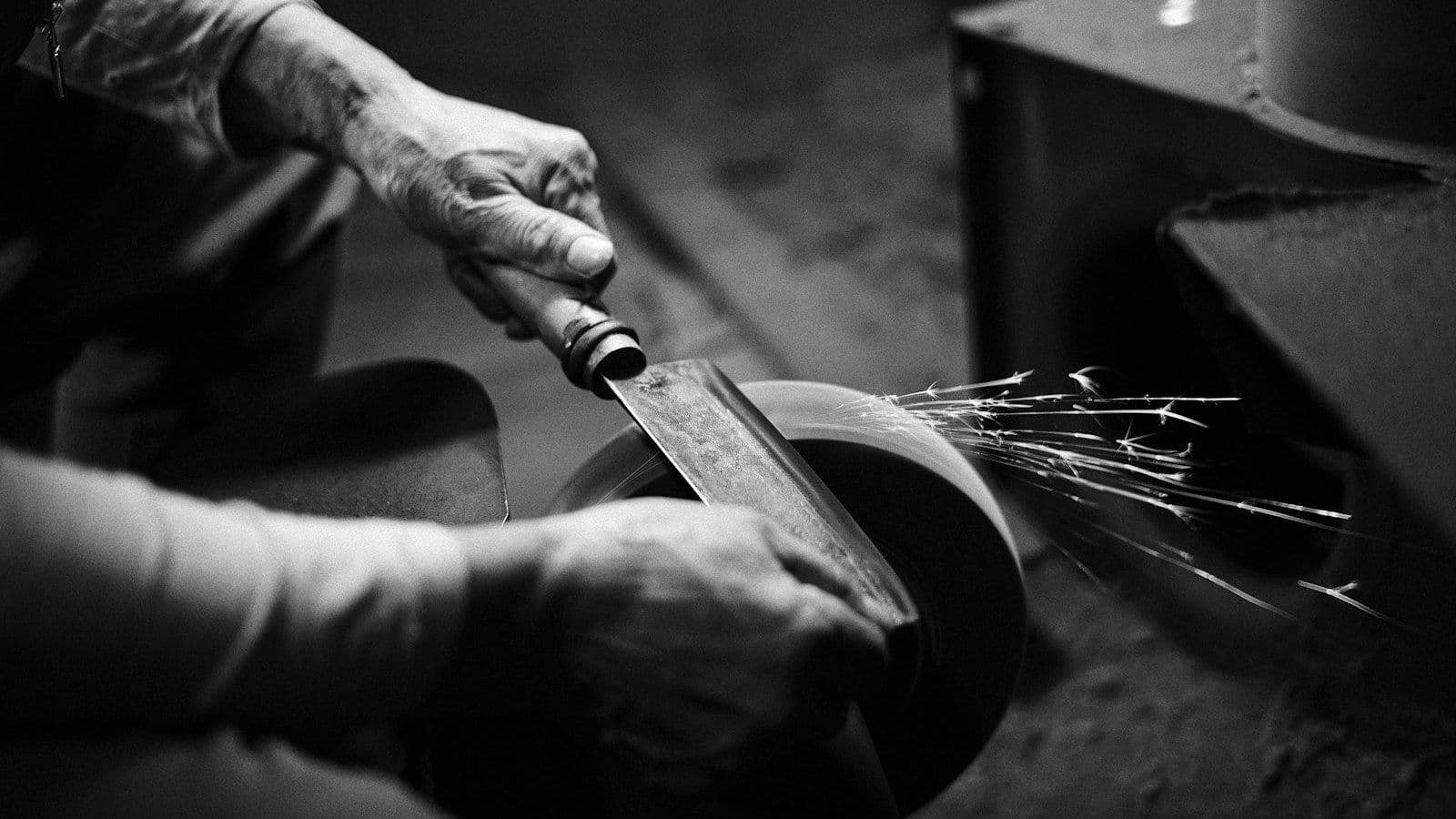
Two cutlers, in the town I have never named. Each had a wheel, a trough of water, a box of horn scales, and the smell of hot steel on sandstone that gets into a coat and never comes out. Both had a thin December.
At the top of the town stood the large firm. Twenty hands, a plate glass window, a yard with its own forge, a half-page in the county paper every Friday with a woodcut of a table knife, and a traveller out on Tuesdays with a baize-lined case. Both cutlers passed that window most days of their lives, and both reached the same conclusion in the same January: that is what money looks like, and the way to have some is to do what they do.
The first cutler acted on it, which took courage. A half-page was beyond him, so he took a quarter-page every week for a year, in sums he felt in his stomach, and put his best lad on the carrier's cart with samples. What came back was not nothing, which is the cruelty of it. The page brought enquiries, mostly for a pocket knife he did not make, and the lad brought orders he could not fill at his own quoted price, since he quoted for goods bought in and the firm for goods it made by the gross. At the year's end his trade stood where it had stood, less the paper's bill and the lad's Tuesdays.
The second cutler did something duller. He spent two afternoons finding out. He talked to the man on the firm's gate, who had no reason to lie. He asked the newspaper clerk what the firm bought and for how long. And he asked the keeper of the inn whose knives he ground what he read on a Friday.
He learned three things, none of them in the window. The half-page was not there to bring a man in off the street. It was there so that in March, when the inn and the infirmary and the big houses put out their orders, the name sat already in the buyer's head and the committee could point at something printed. The traveller did not sell grinding; he carried nine lines of goods the firm made itself. And under both sat a contract for a table knife for the railway hotels, which paid the wages whatever the parish did.
So he bought no page. There was nothing in it he could copy, and what he could copy was smaller. Every blade the firm sold carried its name and street stamped into the tang, so that twenty years on a householder with a dull knife knew where to send it. That cost a punch from the toolmaker. And since somebody up there was plainly ready for March, in February he wrote by hand to every house and inn whose knives he had touched in three years, saying he would be grinding on the Thursdays of that month.
A year on, the railway hotels were not his and never would be. But the inn was, the infirmary sent its scissors, and the February round had become a thing the parish expected. The other man was paying the newspaper office off at a shilling a week.
The Lesson, Since You've Earned It
You can only copy what you can see the whole of, and the part of a business that faces the street is never the whole of it. One walked round the back. The other mistook the shop front for the shop.
Consider what a visible practice is. It is the last link of a chain running out of sight: the thing that pays for it, the buyer it is aimed at, the stock it sells. You see the half-page. You cannot see the contract that makes it a rounding error, nor that it speaks to four buyers you never meet. Copy the act and you buy its whole cost without one of the reasons it pays.
There is a worse trick in it. The largest firm in a trade is the one most likely to be doing things that only work at its size, since its practices are selected for scale, the very quality you lack. The ones that travel downwards are dull, which is why nobody copies them: the stamp on the tang, the February letter, being ready before the orders come out. And you only see the firms still standing. Every town has had three men who took a page and closed, and their pages are not in front of you to be counted.
None of which is an argument for sitting still. It is an argument for two afternoons. The second cutler could act with confidence because he asked people with no stake in his decision. Studying the trade above you pays best when you are looking for what none of them will say rather than for something to imitate, and counsel on a decision of this size is worth what it costs the man to be wrong.
Two cautions. This is no rule against copying. Much of what larger firms do is cheap, portable and better than what you do, and you should take it without ceremony. The test is whether it stands alone or leans on something you do not have. The second caution is nearer to pride. Do not decide the large firm is foolish. It is answering a question not yet put to you, and the day your trade grows, it will arrive.
Three questions, to be asked before the money and not after:
- What pays for it? Not what it costs them, but what revenue stands behind it. A practice funded by a contract, own-made goods or ten years of saved trade is not available to you at any price.
- Who is it aimed at? Often somebody you never see: the committee, the buyer who orders in March, the customer who takes forty of a thing. If it exists to reach a buyer you do not serve, it has no use in your hands.
- What must be true of my trade for this to pay? Write the conditions in three lines before you spend, and mark which you are hoping for rather than holding. The hoped-for ones are where the money goes.
The Answer to the Riddle
Which of the two had the inn's knives on his bench, and what had he done before he spent a penny?
The second, and what he had done was ask three people what the half-page was for. He found it aimed at a buyer he did not have and paid for by a contract he could not get, and so did the only sensible thing, which was nothing. Then he copied what he could see the whole of.
The verse:
The window shows you what they do,
It never shows you why;
So walk around and ask the gate
Before you go and buy.
Until next time. Go and write down the one thing you have been meaning to copy from a larger firm, and under it the three conditions that must be true of your trade for it to pay.
The Best Time for Trying was Yesterday...
Ben B. Tilley
P.S. Notice which of the two things he copied has lasted. The February letter must be written again every year. The name stamped into the tang was one decision, made once, and it has sent work back to his door ever since, from householders who only read the handle of an inherited knife.
Also in the archive: The Sign Nobody Read, Twelve Men and Two and Five Months and Two Days.